

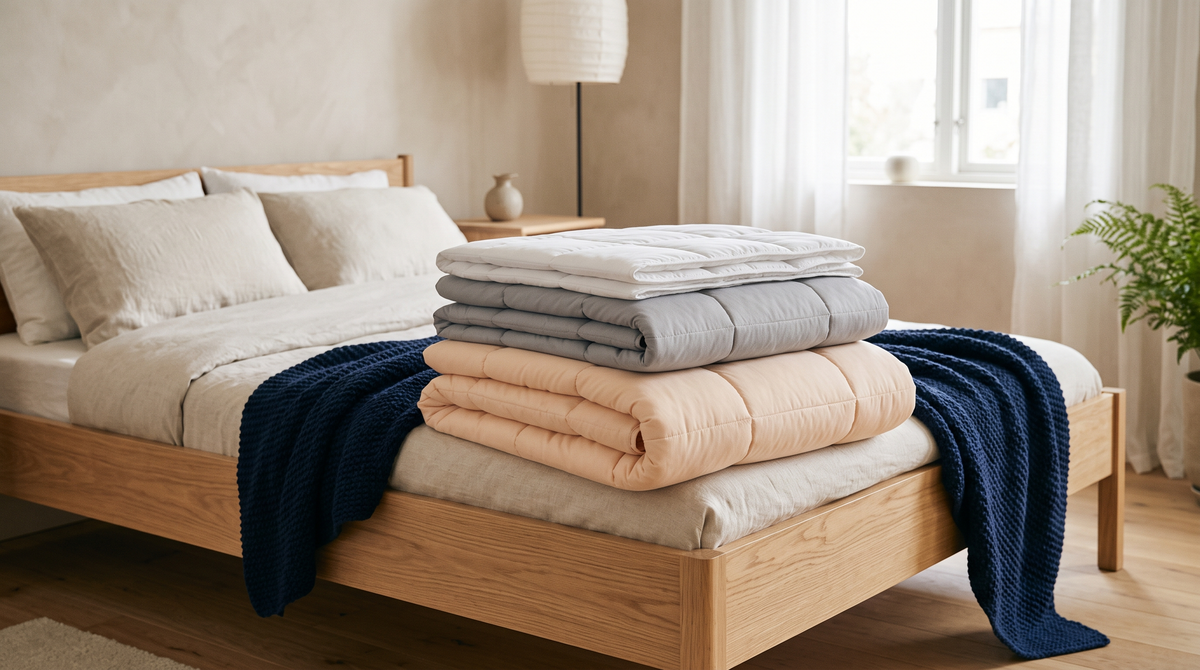
Almost every duvet has one: a warmth rating. But what does that number actually tell you? And is warmth rating 2 at one brand the same as at another? In this article we explain how duvet warmth ratings work, why you should always read them in context and how to choose the warmth rating that suits you.
What is a warmth rating?
A warmth rating is an indication of how warm a duvet is. It is meant to help you choose quickly: are you looking for something light for the summer, something for the whole year or a warm duvet for cold nights?
In the Netherlands and Belgium you often come across a scale from 1 to 5. With most brands, a higher number means a warmer duvet. Still, it is important to know that there is no legally defined, universal scale that every brand uses in the same way.
Note: not every brand uses the same scale
Some brands use a scale with more steps, others work with descriptions such as "light", "medium" and "warm". In the United Kingdom you often see a tog value, another way of expressing thermal insulation. It can also happen that a brand divides the scale differently or even counts in the opposite direction. So preferably compare warmth ratings within one brand, and always read the description that goes with them.
A rough classification
On a scale from 1 to 5 where the number rises with warmth, the classification looks roughly like this. See this as a general guideline, not a fixed rule.
- Warmth rating 1: very light. Often intended for warm summer nights or for people who get warm easily.
- Warmth rating 2: light to medium. Suitable for those who do not like a heavy duvet, or for a well-heated bedroom.
- Warmth rating 3: medium. A popular middle ground.
- Warmth rating 4: warm. For colder bedrooms or those who get cold easily.
- Warmth rating 5: extra warm. Mainly for wintry nights or unheated rooms.
And 4-season duvets?
A 4-season duvet usually consists of two separate parts, for example a light layer and a slightly warmer layer, which you can fasten together with press studs or ties. In summer you use one part, in winter both together. Such a combination therefore does not have a fixed warmth rating, but covers several ratings at once.
What does the warmth of a duvet depend on?
The number is a summary of a few factors:
- The amount of filling. Often expressed in grams per square metre (g/m²). With the same material, more filling usually means a warmer duvet.
- The type of filling. Down, wool and synthetic fibres such as microfibre each insulate in their own way. So grams per square metre can only be properly compared for the same type of filling.
- The construction. How the duvet is quilted affects how the filling is distributed and how much air is retained.
How do you choose the right warmth rating?
Look at your bedroom
A bedroom that stays cool at night calls for a warmer duvet than a well-insulated attic room that heats up in summer.
Look at yourself
Do you get warm easily, or do you often lie there shivering? That also determines your choice. If you sleep with two people and your preferences differ, a medium warmth rating is often a good compromise, possibly supplemented by a throw on one side.
One duvet or several?
You can choose one duvet for the whole year, or switch between a summer and a winter duvet. Read more about this in our article on choosing between a 4-season duvet and a summer duvet.
The Snoozella warmth rating
The ComfyBed has warmth rating 2 and 300 g/m² microfibre filling. It is intended as a duvet for the whole year: airy enough for the warmer months and comfortable in a normally heated bedroom in winter. The reversible ComfyBed Duo is also a duvet for the whole year. There is also a lighter Summer duvet for warm nights.
Because all Snoozella duvets have an attached cover, you can wash them as a whole at up to 60 °C. View the duvets for the whole year or first read which size fits your bed.
Read also
- 4-season duvet or summer duvet: which should you choose?
- Microfibre or down: which duvet suits you?
- How long does a duvet last and when should you replace it?
Frequently asked questions
Is a higher warmth rating always warmer?
With most brands, yes, but not every brand uses the same scale. So always read the brand's own description.
Can I compare grams per square metre between down and microfibre?
Not one to one. Different fillings insulate differently, so preferably only compare g/m² within the same type of filling.
Which warmth rating do I need for the whole year?
That depends on your bedroom and how easily you get warm or cold. A light to medium warmth rating is a comfortable choice for the whole year for many people.


