

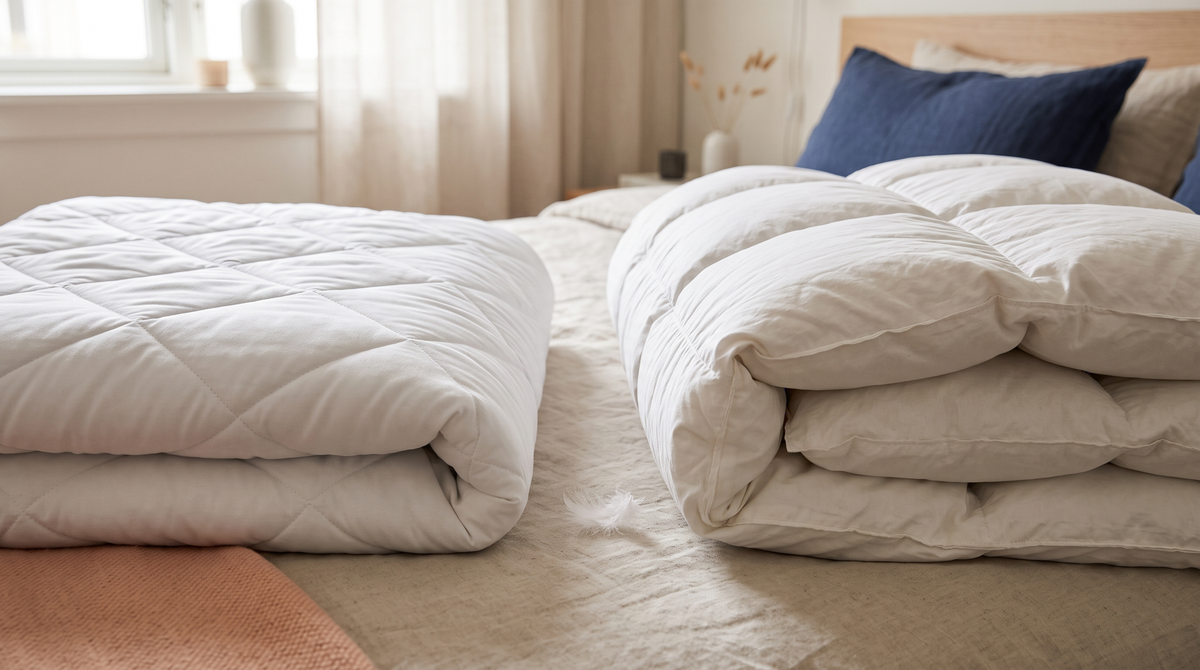
When choosing a new duvet, the filling is one of the most important decisions. Two popular options: down and microfibre. Both have their own character, their own advantages and their own points of attention. In this article we compare them honestly, so you can choose what suits your wishes and way of life.
What is a down duvet?
A down duvet is filled with down, the soft underlayer of the plumage of ducks or geese. It is often mixed with small feathers. The percentage of down partly determines how light and airy the duvet is.
Characteristics of down
- Light in relation to the warmth it provides.
- Soft and supple, it drapes nicely around you.
- Requires careful maintenance: washing is possible, but often at a lower temperature and with a long drying process.
- Often used with a separate duvet cover.
What is a microfibre duvet?
Microfibre is a very fine synthetic fibre. In a duvet it is used as filling, and sometimes also as the outer fabric. It is a commonly used material for duvets that you want to be able to wash easily.
Characteristics of microfibre
- Soft and light, with an even filling.
- Copes well with regular washing.
- Usually dries faster than a down filling.
- Suitable for those who prefer not to use animal materials.
Down and microfibre side by side
Warmth
Both materials can be made in different warmth ratings. The warmth depends on the amount and type of filling. So only compare the amount of filling (g/m²) within the same material; down and microfibre each insulate in their own way.
Care
This is often where the biggest difference lies. A down duvet needs more care when washing and especially when drying, because down must be completely dry so it does not clump or smell. That is why many people only have a down duvet washed occasionally. With many duvets, microfibre can go in the washing machine more often and at a higher temperature. Snoozella microfibre duvets, for example, can be washed at up to 60 °C.
Feel
Down feels light and supple and moulds around you. Microfibre also feels soft, and a well-quilted microfibre duvet keeps the filling evenly distributed. The feel is personal: what one person loves, another finds too heavy or too light.
Animal materials
Down is an animal product. If you prefer to avoid that, a synthetic filling such as microfibre is a logical choice.
House dust mites and allergies
If you suffer from a house dust mite allergy, it is often nice to be able to hot-wash your bedding regularly. A duvet that is washable up to 60 °C makes that easier. Read more in our article on keeping your bed fresh with house dust mites.
Which suits you?
Choose down if...
- you love a very light, supple duvet;
- you do not mind washing carefully or taking the duvet to be cleaned now and then;
- you like working with separate duvet covers.
Choose microfibre if...
- you want to wash your duvet regularly yourself in the washing machine;
- you are looking for a duvet that can go in the tumble dryer;
- you prefer not to use animal materials;
- you love a simple, easy-care bed.
Practical tips when choosing
- Read the care label before you buy. What temperature, can it go in the tumble dryer, and what drum capacity do you need?
- Pay attention to the warmth rating and read the brand's description, because not every brand uses the same scale.
- Choose the right size: at least 40 cm wider than your mattress. See the size guide.
- A sleep trial is ideal: only after a few nights do you really know whether a duvet suits you.
Microfibre at Snoozella
All Snoozella duvets have an outer fabric and filling made of microfibre. They are OEKO-TEX® certified, hypoallergenic and have an attached cover, so you do not need a duvet cover. The ComfyBed has warmth rating 2 and 300 g/m² filling. Washing is possible up to 60 °C, and afterwards the duvet can go in the tumble dryer. View the duvets for the whole year and try one with a 30-night sleep trial.
Read also
- Duvet warmth ratings explained
- Bothered by house dust mites? How to keep your bed fresh
- How long does a duvet last and when should you replace it?
Frequently asked questions
Is microfibre warmer or cooler than down?
That depends on the amount of filling and the warmth rating, not just on the material. Both are available in light and warm versions.
Can a down duvet go in the washing machine?
Often yes, but always follow the label. Down usually needs a lower temperature, a roomy drum and a long, thorough drying time.
Is microfibre suitable if you get warm easily?
Then mainly choose a light warmth rating. The warmth rating says more about how warm a duvet is than the material alone.


